

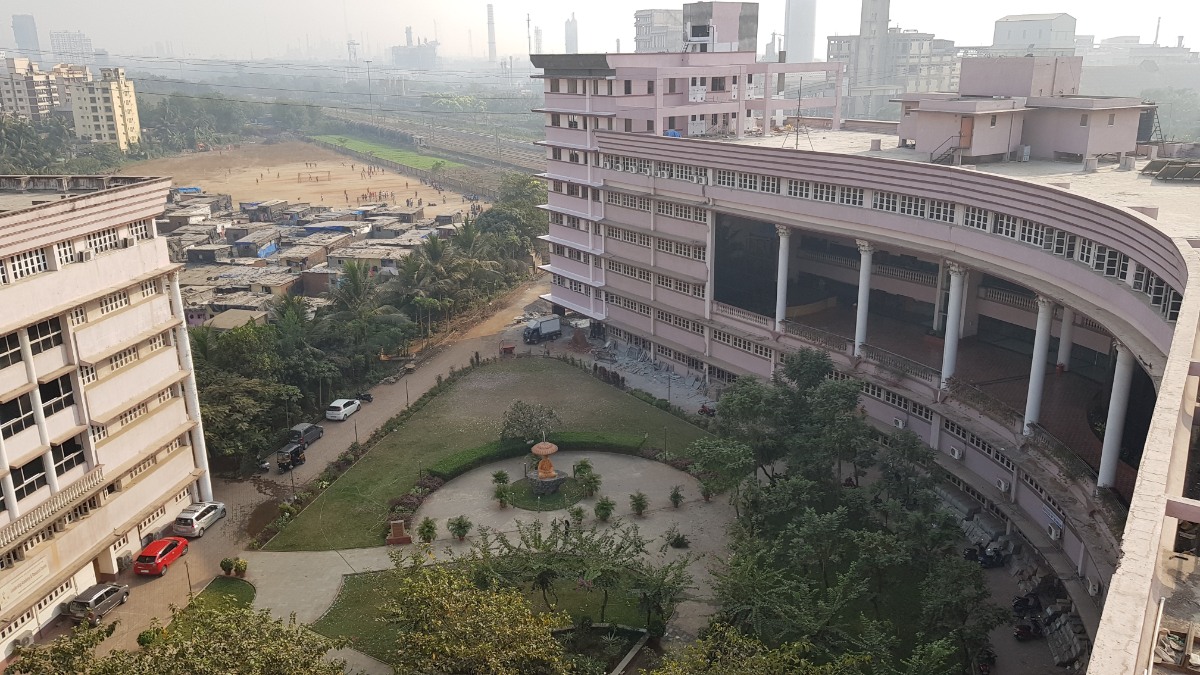
Architecture has always been taught as a discipline rooted in structure, form, and precision. Students learn to think in terms of lines, measurements, and blueprints, and that foundation still matters deeply. But if we step back and look at how the world is changing, it’s clear that this alone is no longer enough.- Dr. Prof. Anand Achari
Architecture education needs to reflect a world where design is not just about creating spaces, but about responding to systems, climate systems, data systems, and human behaviour in real time.
One of the biggest shifts is the role of AI in design. This is no longer theoretical. Today, tools like generative design software can produce hundreds of layout options in minutes based on inputs like light, airflow, space usage, and cost. For example, a student designing a housing project now has access to tools that can check building performance by instantly testing different building orientations to identify the option that reduces heat gain in India’s hot climate while improving the ventilation. The architect’s role, therefore, is shifting, from manually producing every iteration to interpreting, refining, and making judgment calls on AI-generated possibilities.
At the same time, the industry is also now progressing beyond 3D modelling and Building Information Modelling (BIM) towards Building Performance Modelling (BPM). While BIM focuses on documenting and coordinating a building’s design, BPM focuses on how they actually perform in areas such as energy use, thermal comfort, daylight, ventilation, and carbon impact. As sustainability becomes a priority, performance is increasingly becoming a key design parameter from the very beginning.
But most architecture classrooms are still catching up. In many cases, these tools are introduced late or treated as optional skills, when in reality they are becoming part of everyday practice.
Then there is climate intelligence, which is no longer a side topic; it is central to design. Buildings today are expected to perform under environmental stress. For instance, designing a school in a heat-prone city like Jaipur is no longer just about layout and aesthetics. It involves understanding passive cooling techniques, material heat retention, shaded courtyards, and even roof design that reduces indoor temperature naturally. A well-designed building today reduces dependence on artificial cooling, not one that simply looks modern.
This is where education must go deeper, into how sustainability, climate, materials, and energy systems interact, not just how structures are drawn.
The gap between studio learning and real-world execution is another challenge. In studios, students often design without fully confronting constraints like cost, approvals, or construction feasibility. But in reality, every design decision is a trade-off. For example, a large glass façade may look visually striking in a presentation, but in practice, it can dramatically increase cooling costs in a tropical climate unless carefully engineered.
This is why early exposure to real projects matters. Even simple internships or live case studies, like redesigning a local public space or working on affordable housing layouts, can help students understand how design behaves outside the classroom.
What is becoming increasingly clear is that architecture is no longer just about designing buildings in isolation. It is about designing for context, climate, technology, economy, and community all at once.
Blueprints will always remain the language of architecture. But they are no longer the full conversation. A future-ready architect is someone who can use AI as a design partner, think deeply about climate impact, and still stay grounded in the realities of how buildings are actually built and lived in.
That shift is already underway. The question is how quickly education is willing to catch up.
By: Dr. Prof. Anand Achari, Principal – VES College of Architecture